

Event name: Techjobsday 2022
Organiser: Reteinformaticalavoro
Year the event was held: 2022
Duration: 2 days

Products used
SharEvent event management platform
SharEvent virtual trade fair
Highlights
For the third consecutive edition, Reteinformaticalavoro chose to run its annual job fair entirely virtually and to work with SharEvent as its technology partner.
After years in which moving the fair into the virtual dimension had been driven by the pandemic, in 2022 the decision to keep it entirely virtual was based on the excellent results achieved — good enough that there was no case for going back to a physical event.
Two factors in particular decided it: the number of interviews held across the two days of the fair (226, from 1,550 appointments) and the assurance, for companies and professionals alike, that the whole process of matching supply and demand could be handled conveniently, quickly and securely.
The event
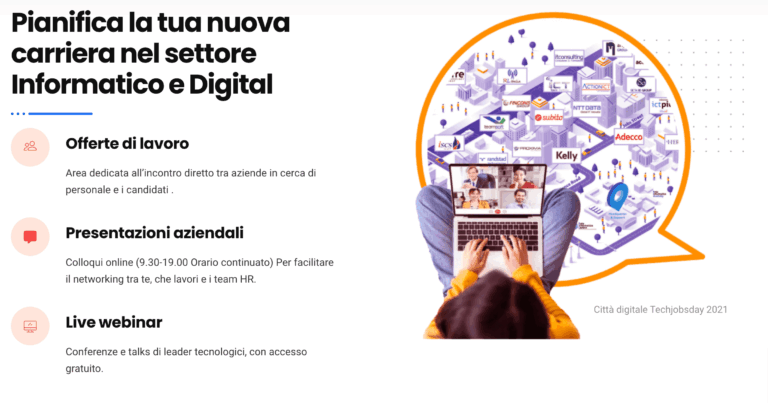
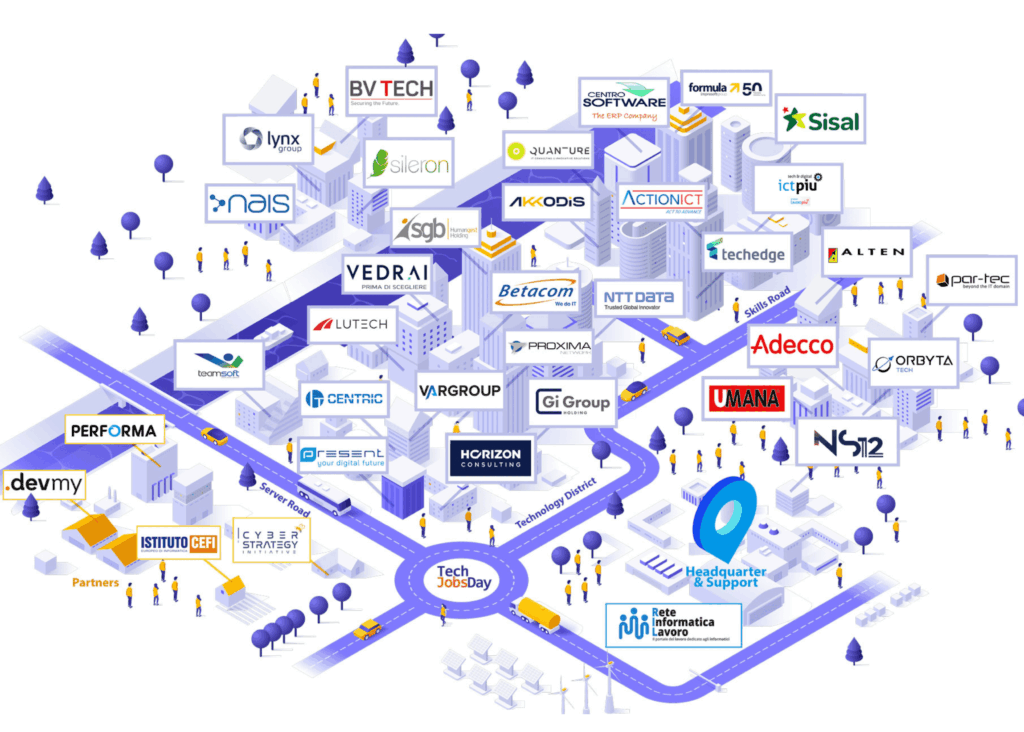
The two-day fair exists to bring together supply and demand for jobs in the tech sector inside a digital space called the “Digital City”.
Its objectives are therefore to:
- attract tech professionals (junior and more experienced alike) interested in making contact with companies in the sector;
- attract tech companies interested in hiring;
- establish the fair as a point of reference for the sector in matching supply and demand for specialist tech roles;
- build networks of relationships between tech professionals, and between professionals and companies;
- give companies effective, efficient tools for arranging meetings with professionals and selecting them.
The challenges
The main challenges of the event concerned:
- delivering an experience in the virtual space that was both attractive and functional for companies and attendees alike, in order to draw in the target audiences, make the most of them and create the best opportunities for active participation;
- creating spaces and tools for networking and for exchanging skills and ideas — or simply for tech professionals to get to know one another and to get to know the companies;
- creating opportunities for learning and professional development that would showcase what the companies do and appeal to professionals;
- creating functional, well-equipped spaces for matching supply and demand in the job market, with particular attention to:
- visibility and branding of the company spaces;
- the ability to run appointment diaries with bookings;
- the ability to handle the exchange of documents (CVs) in a practical and secure way.
The solutions
- Virtual trade fair
With SharEvent Virtual Trade Fair we created a bespoke virtual environment in which every company had its own virtual office: a fully brandable space in which it was possible to:
- tell the company’s story
- schedule interviews
- flag current job openings
- set out the details of the profiles being sought
- Booking and managing appointments
The beating heart of the event was the system for managing the interviews between companies and professionals, from booking them through to assessing CVs.
The process was designed and built down to the last detail to guarantee functionality, security and a pleasant experience, and was therefore structured as follows:
- Creating the appointment diary
Each HR manager was able to create their own appointment diary , setting out for each day of the fair the times they were available for interviews (10am–12pm and 3–6pm, for example) and the corresponding bookable slots (specifying 15-minute appointments, for instance, meant SharEvent created four slots for every hour of stated availability).
- Publishing the appointment diaries
The diaries were made available to attendees, who could then book their own appointment themselves, choosing directly from the available times.
- Approving or declining interviews
On registering for the fair, every attendee was asked to upload their CV to their personal area as a precondition for booking interviews with companies. That let companies’ HR managers read the CVs at the point of booking and decide whether to accept or decline the interview. Only on acceptance was the appointment confirmed, with a notification sent by browser and by email to both the candidate and the HR manager.
- Managing diaries and changes
Each company could not only monitor the bookings made against the slots in its diary but also change appointment times, moving candidates into different slots, or mark certain times as unavailable. Where appointments were moved, candidates were notified of the change in real time.
- Managing interview invitations
To get the best possible match between supply and demand during the fair, the HR managers of every participating company could filter the list of registrants (by skills or home city, for example) and invite them by email to book an interview.
- Holding the interviews
Each company could add to the platform the link to its own call for holding the interview.
NOTE:
every activity and procedure relating to organising and running the interviews — from managing appointments to assessing CVs, from sending communications to networking — applies equally, with the same functionality and convenience, to in-person events, because the system can still handle the whole path before and after the interview in an integrated way even when the interview itself takes place in person. That makes the system particularly versatile for events run in different formats too (online editions, hybrid editions, in-person editions).
- Networking
By creating spaces and occasions and by providing purpose-built tools, networking was encouraged between professionals and between professionals and companies, to promote both getting to know one another and exchanging information. These activities further stimulated the building of relationships and increased both the number of appointments arranged and the number of interviews actually held.
- Webinars
As further support for HR and recruitment, a busy calendar of webinar workshops set out to highlight the technical and operational particularities of the companies at the fair, and so gather around them a more specific interest from professionals. That helped raise the quality — and therefore the value — of the resulting appointments and interviews, while cutting wasted resources and wasted time for both sides.
Conclusions
Starting from the objectives of the event — bringing together supply and demand for jobs in the tech sector — Techjobsday 2022 succeeded in creating value through technology.
As an online event, the essential asset was the “Digital City”: an online space that had to be attractive and functional, enjoyable and practical, for every stakeholder involved. That was achieved by creating a branded, bespoke space in which not only the promoters and the companies could be shown to advantage, but all the central functions were available (exhibition space, a system for booking and managing meetings, exchange of documents and information) along with supporting services such as professional development and training (workshops) and networking and the building of relationships, including informal ones.
Holding this complex architecture together was made simpler by the fact that the skeleton moving it was a single one: the SharEvent platform, which allowed the two levels of activity required — direct operation by the event organisers, and self-service management by individual participants, mainly for arranging and delivering the interviews. A single system able to operate on two levels at once reduced the management complexity of such an elaborate project while keeping everything under control, and gave individual participants the autonomy they needed to run things according to their own requirements and possibilities.